Cold Hands, Cold Showers: How to Tell If Your Gym Is Winter-Ready
Every gym looks decent in June. Doors propped open, windows that actually open, a changing room that dries out between users, and enough floor space that nobody is queuing for a bench. Then the clocks go back, the heating comes on, the doors stay shut, and you find out what the place is really made of.
I have trained in council leisure centres with radiators you could roast a chicken on and windows painted shut, and in shiny chains where the air handling was so aggressive you left with a sore throat. Neither is a disaster. But winter is when the small stuff stops being small: a cold changing room turns a 45-minute session into a 25-minute one, and a shower that never gets above lukewarm is the reason you stop going on Tuesdays.
So here is a practical way to judge your gym before the cold really bites. No special equipment. Just a bit of attention, and possibly two towels.
Start at the door
The first thirty seconds tell you a lot. Walk in and note the temperature at ankle height versus head height. Cold air pools, and if the entrance is a wind tunnel, that cold is being dragged straight across the free weights by every person who comes through.
Things worth looking at:
- A second door, a curtain, or a lobby. A single door straight onto the street is a chimney working in reverse.
- Matting. If the entrance mat is soaked by 7am, that water is going into the changing room and staying there all day.
- Where the cold air lands. If it lands on the stretch mats, that is precisely where people give up on warming up.
Ask at reception whether the heating and the ventilation run on the same timer. Quite often they do not, which explains why the place is arctic at 6:30am and stuffy by 6pm.
The warm-up problem nobody plans for
Most gyms have a warm-up area in theory: a few mats, a stretch cage, a corner by the mirrors. In winter that corner becomes the coldest part of the building, because it is furthest from the door and furthest from any body heat.
If you can see your breath while doing a hip opener, that is a fail. Not because cold air is dangerous in itself, but because nobody warms up properly when they are miserable, and a skipped warm-up is how January ends with a tweaked hamstring and a fortnight off.
Ask yourself: is there space where you can do five minutes of easy movement without wearing a coat? If not, the cardio machines become your warm-up. Ten minutes on a rower, bike or cross-trainer, building from easy to moderate, then straight into your session. Not elegant, but reliable.
Ventilation — the bit people get backwards
Cold weather makes everyone want to seal the building. Gyms then get stuffy, the mirrors steam up, and by February the place smells like a wet dog that has been to a spin class.
You want air moving, not simply warm. Signs it is being handled: extractors you can hear in the changing rooms, windows that open even a crack, and no fog on the glass after a busy class. Signs it is not: condensation running down the inside of the windows, a heavy smell that arrives at 6pm and refuses to leave, and staff propping the fire door open as the entire ventilation strategy.
Worth asking outright: when were the filters last changed? It is a dull question that gets a surprisingly revealing answer.
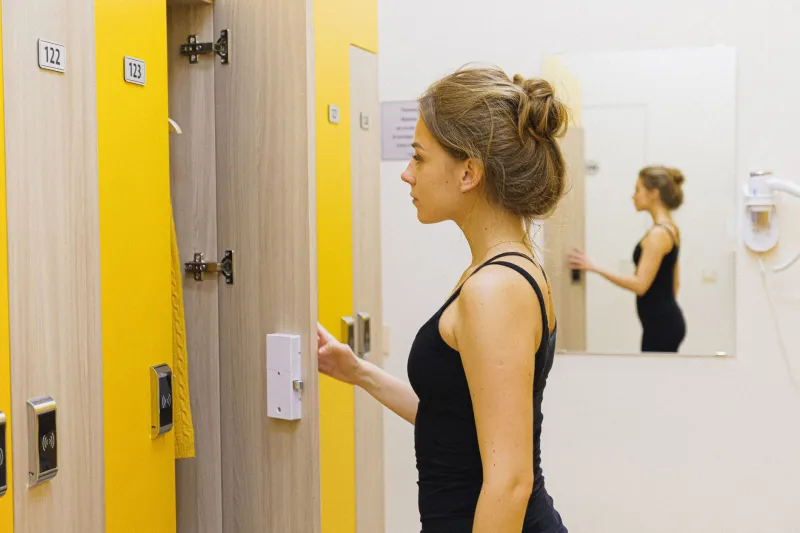
Changing rooms, showers, and the great hairdryer question
This is where a winter gym is won or lost. You can train in a cold hall for an hour. You cannot comfortably get dressed in a chilly changing room at 7:45am with wet hair and a bus to catch.
Check for:
- Draughts at floor level. Put your hand down near the bench and wait ten seconds.
- Bench space. Cold weather means coats and bags, which means half the bench is now luggage.
- Shower temperature and pressure. Test it properly. Not for a second, give it a full minute. A shower that takes 90 seconds to run warm is a shower most people skip.
- Drying space. Somewhere to hang a wet towel that is not your own bag.
- Hairdryers that work. Two broken out of three is the standard UK gym situation, but it is worth knowing before you rely on one.
This is the two-towel test in its simplest form. Bring one towel for you and one for the bench or the floor, and see whether you leave the place dry, warm and genuinely clean. If the answer is no, you will quietly find reasons not to go back, and none of them will sound like the real reason.
The class question
Winter hits timetables hard. Instructors get ill, studios get cold, and a 6:30am class with three regulars quietly vanishes from the schedule in February.
Ask at the desk which classes ran all the way through last winter and which got pulled. Also ask how much notice you get if a session is cancelled. Some places text you an hour ahead. Others let you turn up to a locked studio. Both tell you something about how the place is run.
If your gym fails, adapt the session rather than abandoning it
You are not necessarily changing gyms over a draught. Practical fixes that work:
- Train in layers and strip down. Base layer, thin mid layer, and a hoodie that comes off after the first set. You will be warm within eight minutes.
- Warm up on a machine, not a mat. Ten minutes of easy cardio beats five minutes of shivering by the water fountain.
- Front-load the session. Do the thing you came for in the first 25 minutes, rather than saving it for a finish you may not have the patience for.
- Shower at home if you can. Quick towel-down, coat on, ten minutes back to the flat. Less pleasant, but it removes the excuse entirely.
- Keep a spare towel and a hat in your bag. Small, slightly ridiculous, genuinely effective.
- Try quieter hours if peak times are cold. Less door traffic means less heat escaping, even if there are fewer bodies in the room.
Asking the right questions
None of this needs to be confrontational. A short list gets you most of the way:
- Does the heating come on before the first class of the day, or with it?
- Are the changing room extractors on the same circuit as the lights?
- Which classes ran all winter last year?
- Is there anywhere indoors to warm up that is not the main floor?
Staff usually answer honestly, and the answers tell you whether the building is being managed or simply occupied.
The short version
A winter-ready gym is one where you can walk in cold, warm up properly, train for 45 minutes, shower, and get back out without feeling like you have survived an expedition. If yours cannot manage that in November, it certainly will not in January.
Ask the boring questions. Test the shower. And if you are gym-shopping right now, go on a wet Tuesday evening rather than a sunny Saturday morning. You will see the real place, not the showroom.