Standing Room Only: A Four-Week Strength Plan for the Shallow End
There's a particular kind of person who walks into a leisure centre in November, glances at the pool timetable, sees the word 'lanes' and quietly turns round. Maybe that's you. Maybe you can swim a bit but you're not fast, or you're nursing a knee that objects to the gym floor, or you're 68 and the free-weights area smells of protein powder and judgement. Either way, the shallow end is sitting there, warm and empty, being completely ignored.
It shouldn't be. Water up to your chest is one of the most forgiving places in the building to build strength, and you don't need to put your face in it once. This is a four-week plan for people who want a proper session, not a splash about.
Why water is a legitimate strength tool
Two things happen when you stand in chest-deep water. First, you feel lighter — roughly a tenth of your body weight through your feet at that depth, less as you go deeper, which takes pressure off hips, knees and ankles. Second, and more usefully for training, the water fights back. Every time you move a limb, you're pushing against drag, and the faster you move, the harder it gets. That's adjustable resistance without touching a single plate.
Add the warmth of a typical leisure pool — often around 30 to 31°C, warmer than a lane pool — and you get a space that suits stiff joints, older bodies, and anyone who's been told by a physio to 'stay active but take it easy'. The hydrostatic pressure also does quiet work on swelling in ankles and calves, which is why a lot of people with arthritis and post-injury knees feel better after twenty minutes in the water than after twenty minutes on a cross-trainer.
Is it the same as a barbell session? No. You won't build a 100kg squat in the shallow end. But as a starting point, a rehab bridge, or a second weekly session alongside the gym, it's genuinely good — and it's already paid for if you're a member.
The etiquette bit nobody tells you
Most council pools run a mix of lane swimming, aqua classes and general swim. You want general swim, or a quiet afternoon slot — check the timetable on the app or the noticeboard before you go. Turn up in a costume, not your gym kit, and take a towel and a padlock for the locker. Flip-flops are worth it.
A few unwritten rules that will keep the lifeguards on your side:
- Shower before you get in. It's on the sign and it's not optional in most places.
- Don't sit on the pool steps. They're the entry point, and blocking them is the pool equivalent of parking across two spaces.
- If you're using a float or a noodle, take it from the rack and put it back. Don't commandeer four of them.
- Stay in the shallow half and don't wander into a lane. Lane swimmers have a rhythm and you'll break it.
- Tell the lifeguard you're doing a walking session if you're at all unsteady. They'd much rather know.
One safety note: never do breath-holding or underwater work as part of this. You're standing up. Keep your head above water, keep breathing, and get out if you feel light-headed — warm pools can sneak up on you.
The four-week progression
Do this twice a week, 20 to 30 minutes a go, with at least one rest day between sessions. Same session each time within a week; change it week to week. That's it.
Warm-up (every session): four minutes of easy walking in the water — forwards, backwards, sideways — while you get used to the temperature and the drag.
Week 1 — Find your feet
Two rounds of eight repetitions of each of the following, with 30 seconds' rest between moves:
- Walk forwards to the far wall and back. Normal strides.
- Walk backwards the same distance, pushing the water behind you.
- Side-step along the wall, leading with one leg, then the other.
- Step-ups onto the pool steps — one foot up, stand tall, step down. Alternate legs.
- Stand an arm's length from the wall and push your palms against it, like a slow standing press-up. Hold for two seconds, release.
This week is about learning the depth and finding your balance. It will feel too easy. Do it anyway.
Week 2 — Add a little
Three rounds of ten reps, 30 seconds' rest:
- All of week one, plus:
- Calf raises with one hand on the rail.
- Knee lifts — bring one knee to hip height, hold two seconds, lower.
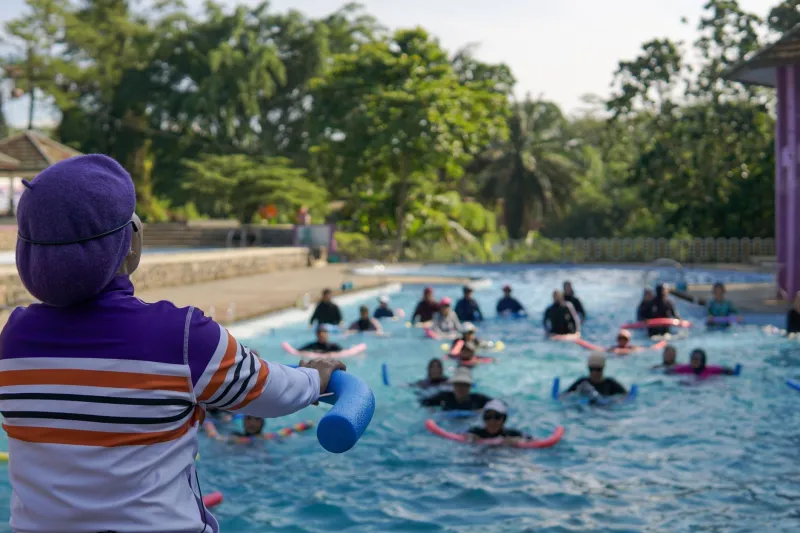
- Noodle tuck — put the noodle under your knees, sit back into the water, and hold a tucked position for ten seconds. This is a core exercise dressed up as floating.
Week 3 — Slow it down
Same moves, but change the tempo. Take three seconds to push your arm or leg through the water, then two seconds to return. Slower movement means more time under tension and a much harder session. Add a 15-second wall sit — back against the pool wall, thighs parallel to the floor, holding the position.
Week 4 — Put it together
Set up a simple circuit. Eight stations, 40 seconds of work, 20 seconds of rest, two full rounds:
- Forward walk
- Backward walk
- Side-steps
- Step-ups
- Wall press
- Noodle tuck
- Calf raises
- Wall sit
That's a proper session. You'll be breathing hard by round two.
What to expect afterwards
You won't be dripping with sweat, which confuses people. Water carries heat away faster than air, so you can work quite hard without feeling it — which is why you should get out when the session ends rather than staying in for an extra twenty minutes and then shivering in the car park. Warm up properly afterwards, especially your calves and hips.
You may be pleasantly surprised by how much less a dodgy knee complains the next morning. You may also be surprised by how tired your shoulders feel — drag is sneaky like that.
Who this suits
This plan works well for three groups. People coming back from injury, because the water supports you while you rebuild. Older adults, because the warmth and the buoyancy make movement possible on days when the pavement feels like a bad idea. And anyone who finds the gym floor intimidating, because nobody in the shallow end is filming themselves for social media.
If you're pregnant, managing a heart condition, or recovering from surgery, check with your GP or midwife first — warm water isn't right for everyone, and pool staff will want to know. If you can't manage the steps, ask about the hoist; most council pools have one and it's there to be used.
A last word
The pool isn't a lesser gym. It's a different one, with better heating and less queueing for the squat rack. Four weeks, twice a week, is a small enough commitment to try. And if you get to the end of it and still fancy learning to swim properly, you'll be fitter and more confident than when you started.